Selecting the right industrial racking system is one of the most important decisions for any warehouse or manufacturing facility. The right choice can double your storage capacity, reduce operational costs, improve safety, and streamline workflow. The wrong choice, however, can lead to inefficiency, wasted space, safety hazards, and unnecessary expenses.
With warehouses becoming more complex and storage demands increasing, businesses need a clear understanding of racking options, load requirements, and operational workflows. This guide breaks down everything you need to know before choosing a racking system — helping you make an informed, strategic, and cost-effective decision.
1. Understand Your Storage Needs
Before selecting a racking system, begin with a complete assessment of your inventory and warehouse layout. Key questions include:
What type of goods do you store — pallets, cartons, long items, or mixed loads?
What are the weights and dimensions of these items?
Do you need fast picking, bulk storage, or high-density solutions?
How frequently do items move in and out?
Are you using forklifts, stackers, or specialized equipment?
Understanding these factors helps determine the structure, height, load capacity, and accessibility required for your warehouse.
2. Evaluate Your Available Space
Warehouse space is expensive, and maximizing it is crucial. Focus on two main areas:
a) Vertical Space
Many warehouses underutilize vertical height. Racking systems like Very Narrow Aisle (VNA), Selective Racking, or Mezzanine Floors help you use the full warehouse height efficiently.
b) Floor Space
If floor space is limited, high-density systems like:
allow you to store more goods without expanding your building.
Taking accurate measurements ensures the chosen racking system fits perfectly and functions safely.
3. Identify the Right Racking System for Your Operation
Each racking system serves a specific purpose. Here’s a simplified guide to help you choose:
Selective Pallet Racking – Best for Accessibility
Ideal if you need direct, quick access to every pallet. Great for warehouses with multiple SKUs.
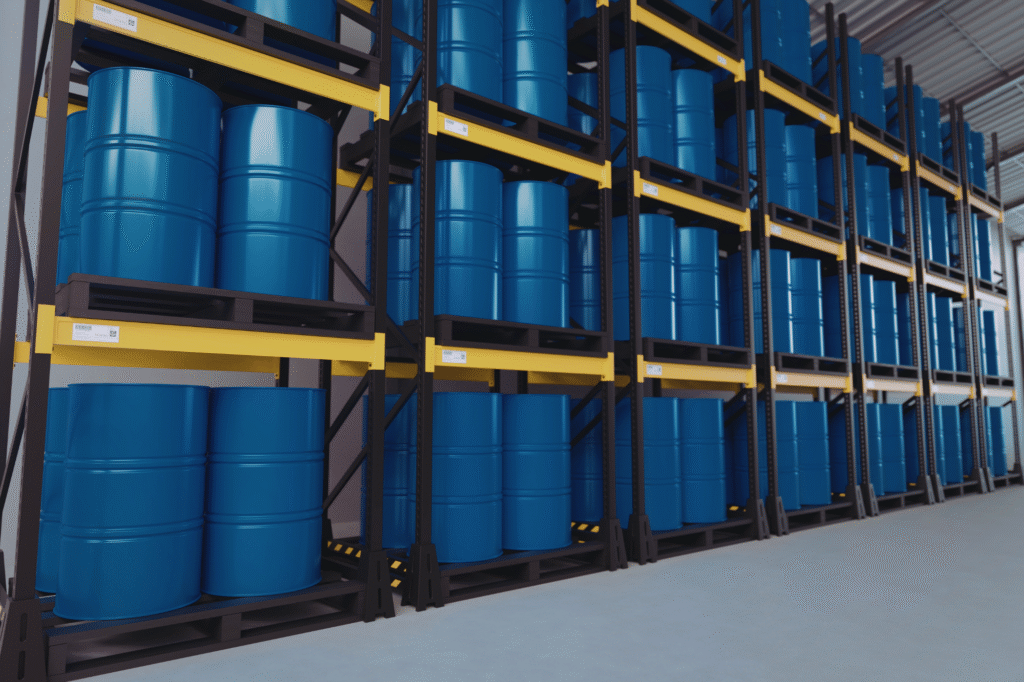
Heavy-Duty Pallet Racking – Best for Strength
Perfect for storing heavy loads, industrial goods, and large palletized items.
Double Deep Racking – Best for More Storage in Less Space
Stores pallets two-deep, increasing capacity while maintaining reasonable access.
Drive-In / Drive-Through Racking – Best for High-Density Storage
Ideal for large quantities of similar goods, especially in cold storage and bulk warehousing.
Very Narrow Aisle (VNA) Racking – Best for Maximizing Height
Allows tall racking and narrow aisles for maximum density using specialized forklifts.
Push Back Racking – Best for LIFO Operations
High-density storage with pallet movement on inclined carts.
Pallet Flow Racking – Best for FIFO Operations
Ideal for fast-moving goods requiring first-in, first-out rotation.
Shuttle Racking System – Best for Automation & Speed
Uses automated shuttles to transport pallets within deep channels, increasing performance and reducing forklift travel.
Cantilever Racking – Best for Long or Irregular Items
Perfect for storing pipes, rods, beams, panels, and oversized materials.
Long Span Shelving – Best for Medium-Duty Storage
Used for cartons, tools, components, or bulky items handled manually.
Choosing the right system depends on the nature of your goods and your operational flow.
4. Consider Safety Requirements and Load Capacity
Safety should never be compromised when choosing racking. Every system must be engineered based on:
Accessories like column guards, decking panels, and pallet support bars add extra security and reduce damage.
A reliable manufacturer like Indorackk Storage System ensures precision engineering, quality steel, and compliance with safety standards — guaranteeing strength, durability, and stability for heavy-duty operations.
5. Match the Racking System With Your Material Handling Equipment
Your racking layout must be compatible with your equipment:
Standard forklifts
Reach trucks
VNA trucks
Stackers
Pallet jacks
Automated shuttles
For example, VNA racking requires specialized VNA trucks, while shuttle systems integrate with automation technology.
A mismatch between equipment and racking can slow operations and compromise safety.
6. Look for Scalability & Future Expansion
As your business grows, your storage requirements will change. Choose systems that allow:
Height adjustments
Adding extra bays or levels
Converting into multi-tier systems
Expanding into mezzanine floors
Indorackk designs racking systems that can grow with your business, ensuring long-term value and adaptability.
7. Work With an Experienced Racking Manufacturer
The right partner ensures:
Accurate warehouse planning
Custom design solutions
Precision engineering
High-quality materials
Professional installation
Long-term support and maintenance
With years of expertise and thousands of happy clients, Indorackk Storage System delivers tailored solutions that perfectly match your warehouse operations.
Conclusion
Choosing the right industrial racking system is more than a purchase — it’s a strategic investment that impacts every part of your warehouse. With the right solution, you can dramatically improve space utilization, speed, safety, and cost efficiency.
Whether your business needs high-density storage, fast picking, or heavy-load handling, Indorackk provides expert-designed systems engineered for maximum performance.